
UEM expands exchange possibilities

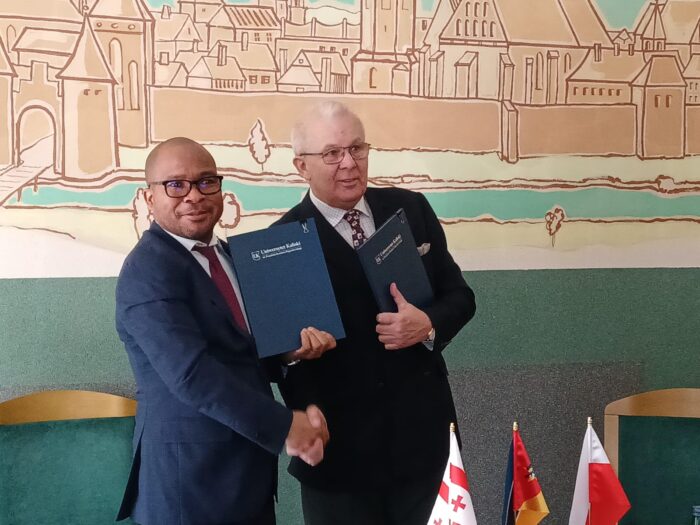
Rectors Manuel Guilherme Júnior and Andrzej Wojtyła, from UEM and UK. Photo: UEM

Eduardo Mondlane University (UEM) has signed a cooperation agreement with the University of Kalisz (UK), in Poland, expanding opportunities for exchange and scientific collaboration between the two institutions.

The partnership, signed in the Polish city of Kalisz, aims to strengthen ties in several academic areas.

Rectors Manuel Guilherme Júnior and Andrzej Wojtyła, from UEM and UK respectively, formalized the agreement, which reinforces UEM's commitment to the internationalization of higher education.

The Erasmus+ program will be one of the main ways for teachers and students to take advantage of these new opportunities for collaboration.

During the visit to Kalisz, Manuel Guilherme Júnior was accompanied by directors and teachers from several units, who gave lectures in areas such as law, tourism, international logistics, marketing, communication and public health.

The sessions were marked by the active participation of students, promoting the exchange of knowledge and strengthening global academic networks.

(By MozaVibe)

A pioneering step in public health

Photo: Freepik

Eduardo Mondlane University (UEM) has developed an innovative solution aimed at real-time monitoring of respiratory diseases among students, technical-administrative staff, professors, researchers and their families. This is the first self-reported information collection application to be implemented for these purposes, consolidating itself as a pioneer in Mozambique.

Developed by the UEM School of Medicine, the application focuses on monitoring respiratory infections, with the aim of assessing the clinical status of the university community and facilitating appropriate medical care.

“We are looking beyond respiratory diseases. The idea is to expand the scope of the system to include other conditions, such as atmospheric poisoning and exposure to contaminants,” explained Alzira Ibrahimo, director of the Faculty of Medicine.

Alzira Ibrahimo further explains that the platform is not limited to respiratory diseases, but can be adapted to monitor other conditions, such as diseases related to atmospheric poisoning and exposure to contaminants.

“The system was designed to be used throughout the Mozambican territory. The idea is to transmit information in real time, which will be a great benefit for public health,” he said.

With geolocation systems and direct integration with health centers, the application allows early detection of health problems and the adoption of more agile and effective measures. All collaborators and users must register on the platform, ensuring a more precise and comprehensive mapping of health in the university community.

With the implementation of this platform, Mozambique joins countries in Europe, Australia, Mexico and the United States, which have invested in syndromic surveillance solutions for public health.

The solution is being presented to the World Health Organization (WHO) guidelines regarding the digitalization of surveillance and early prevention of diseases.

(By Rafael Langa)

UEM leads ranking of employability for young graduates

Foto: UEM

The results of a recent survey on employability in the country, released last week in the capital, reveal that the Eduardo Mondlane University (UEM) is the institution that places the most young graduates into the job market.

Engineering stands out as the field with the highest employability rate, while Social Sciences, Arts, and Humanities face lower demand.

The study, conducted between 2017 and 2019, included 2,100 final-year students from the six largest universities in the country: Eduardo Mondlane University (UEM), Pedagogical University (UP), UniZambeze (Beira), Catholic University of Mozambique (UCM), A Politécnica, and São Tomás University of Mozambique (USTM).

It covered 27 faculties and 106 different courses, with a representative sample of final-year students by gender and field of study, including Education, Arts and Humanities, Social Sciences, Natural Sciences, Engineering, Agriculture, and Health.

According to the survey, the majority of graduates who found employment are not working in their respective fields of study. Additionally, the private sector is identified as the largest employer, following the Health and Education sectors, surpassing the public sector.

The survey also found that, on average, university graduates have a more privileged profile compared to the majority of young Mozambicans.

A significant portion of the graduates come from urban families with a relatively high level of education and permanent employment. After graduation, about 40% of the graduates found employment, with UEM leading the way, accounting for 43% of the employed young people.

Simplifying meteorological language

Photo: Publicity

Meteorological language is complex and needs to be simplified to reach a wider audience. This is the stance of Adérito Aramuge, director of the National Institute of Meteorology (INAM).

Aramuge was one of the speakers at the regional conference "Governing Climate in Vulnerable Contexts: Regional Geostrategies for the Domestication of Natural Risk Management Policies," organized by Eduardo Mondlane University (UEM) in the city of Maputo.

The speaker emphasized the need to simplify the technical language used to address climate issues, arguing that many citizens do not understand meteorological terminology, which hinders the effective dissemination of critical information.
"It is essential that communication is clear and accessible to everyone so that communities can respond appropriately to weather forecasts," he said.

Aramuge also stressed the importance of climate education, proposing the implementation of training programs that help people correctly interpret meteorological information.

In turn, Professor José Langa, from the Environmental Observatory for Climate Change, advocated for greater investment in resilient infrastructure to combat phenomena such as cyclones and floods.
He also highlighted the importance of funding to enable this and other strategies. "Without adequate financial resources, it is impossible to develop and maintain resilient infrastructure or promote educational and training programs," he stated.

Langa also emphasized that international cooperation and investments from public and private entities are vital to ensuring that vulnerable communities can cope with climate change.

The regional conference "Governing Climate in Vulnerable Contexts" brought together various international and national experts to discuss and promote strategies for adapting to climate change, especially in vulnerable regions like Mozambique. It aimed to explore best practices and innovations for mitigating and adapting to natural risks exacerbated by climate change.

(By Renaldo Manhice)

Women in science and technology

Photo: UEM

One of the country's biggest challenges is getting women and girls to school and making them understand that profession is not defined by gender.

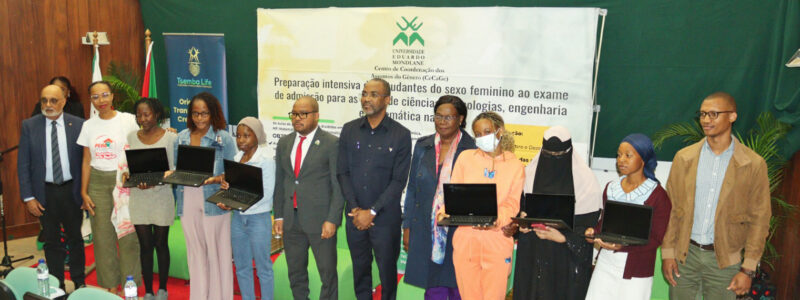
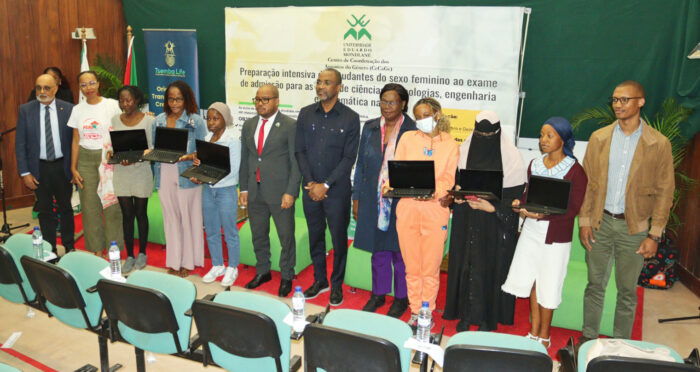
With this in mind, the Eduardo Mondlane University (UEM) created the project "Access for Girls and Women to Science, Technology, Engineering, and Mathematics (STEM) Courses at UEM" in 2019.

The initiative aims to encourage female participation in various scientific fields through lectures and preparatory classes. According to UEM, since its inception, 434 girls have participated in the preparatory classes, resulting in 109 being admitted to STEM courses, with 83 at UEM and 26 at other institutions.

Those admitted to UEM, the country's largest and oldest university, are enrolled in courses offered by the Faculties of Architecture and Physical Planning, Agronomy and Forestry Engineering, and Sciences.

As a result of this project, UEM, in partnership with ExxonMobil Mozambique and Tsemba Life Coaching, awarded 25 scholarships and computers to new female students this week.

(By MozaVibe)