UEM Rector distinguished as Honorary Professor in China

...the rector highlighted his academic career in China, where he completed postgraduate studies at the University of Macau, and pledged to continue working with ZJNU.

Manuel Guilherme Júnior. Photo: UEM

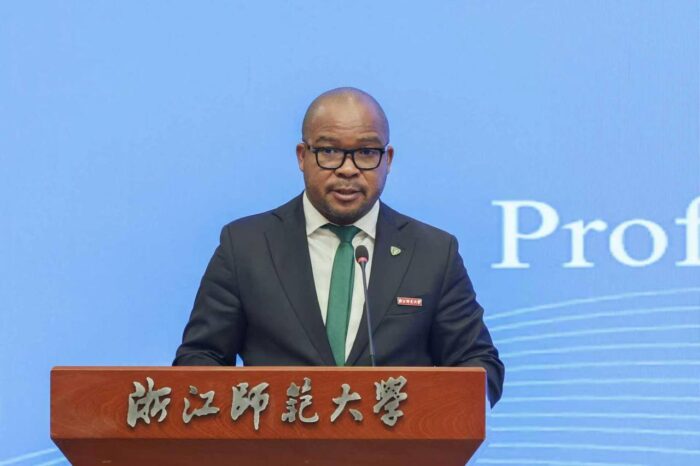
The Rector of Eduardo Mondlane University (UEM), Manuel Guilherme Júnior, was awarded the title of Honorary Professor by Zhejiang Normal University (ZJNU), founded in 1956 and one of the best in China.

This distinction comes in a context of intensified academic relations between UEM and ZJNU, which have seen significant progress, including the strengthening of the UEM Confucius Institute and the creation of joint initiatives such as the Silk Road Academy for Smart Agriculture and the China-Mozambique Joint Laboratory in this area.

On the occasion, the Rector highlighted his academic career in China, where he completed postgraduate studies at the University of Macau, and pledged to continue working with ZJNU, led by Professor Jiang Yunliang, to deepen academic cooperation, focusing on training talent with a global vision and the sustainable development of both countries.

Manuel Guilherme Júnior holds a PhD in Law from Eduardo Mondlane University, where he is a lecturer and researcher in the Faculty of Law. He has published works such as “Manual of Mozambican Commercial Law Vol. I” and “Legal Regime of the State of Emergency in Mozambique” (2020), and is also the author of several scientific articles.

(By MozaVibe)

You don't need to be a genius to get a Chevening scholarship

In a country where access to international scholarships is still not widely publicized, the story of Elina Ricotso Chiluvane emerges as an encouragement for young people who believe that studying abroad is a distant dream.

A mother, married, and a professional in the financial sector, she built her career based on persistence and the conviction that success depends more on preparation than on extraordinary talent. This is how she won the prestigious Chevening scholarship, one of the most competitive in the world.

Graduated in Accounting and Finance from Eduardo Mondlane University (UEM) in 2018, she worked for six years in the financial sector. Despite her experience, she felt she needed to go further.

“There was a gap in the area of ​​financial planning and reporting. I wanted to broaden my knowledge and have a wider horizon,” she explains. This desire for professional growth became the starting point for her application.

The opportunity arose through her husband, who told her about Chevening. From that moment on, she began an intense research phase. She sought information from former scholarship recipients, family, and acquaintances, and immersed herself in the internet to understand the eligibility criteria.

She discovered that it was necessary to have a bachelor's degree, fluency in English, and meet the academic requirements of the universities, in addition to submitting a solid application. The fact that the scholarship was fully funded reinforced her confidence.

The application process proved demanding. Candidates must write four fundamental essays. The first addresses leadership, requiring real-world examples of impact and transformation. The second deals with networking, showing how the candidate mobilized people and partnerships to achieve objectives. The third explores the reason for choosing the country, the scholarship, and the universities. The fourth requires defining a career plan with short- and long-term goals.

In addition to applying for the scholarship, it is necessary to apply separately to three universities. Elina chose the Master's program in Investment and Finance at the Strathclyde Business School, University of Strathclyde, in Glasgow, Scotland, attracted by the institution's academic reputation.

To increase her chances of success, she connected with candidates and fellows from various countries, participated in international groups, sought mentorship, watched videos, and simulated interviews. “The research and preparation made all the difference,” she says.

Even with funding, the initial phase involved personal costs. Among them were the academic English exam, the tuberculosis test, and communication and internet expenses. In total, she estimates having spent around 50,000 meticais.

One of the most difficult moments was when the tuberculosis test was inconclusive due to the flu, delaying the process and almost jeopardizing the opportunity. Determined, she managed to postpone the scholarship until the following year, something uncommon. “It was a lesson in persistence. We can't give up,” she recalls.

BEST AFRICAN STUDENT

Her academic journey was not easy. As a non-native English speaker returning to academia after six years, she faced linguistic and methodological challenges. Even so, she managed to overcome them and transform difficulties into achievements. She graduated with Distinction, obtained a High Performance Certificate, and received the Bashourun Abiola Award in Accounting and Finance, given to the African student with the best academic performance in the department.

After returning to Mozambique, she found employment in financial planning and analysis, achieving the goal that had motivated her from the beginning. Today, she shares her experience with other young people and insists that the main secret is having clear objectives and believing in one's own potential.

“You don't need to be a genius to get a scholarship. You need focus, preparation, and hard work,” she emphasizes.

For Elina, it is crucial that scholarship opportunities are more widely publicized in the country, allowing more young people to access international training. Her trajectory leaves a clear message: dreams become possible when there is information, persistence, and courage to face challenges.

(By Renaldo Manhice)

Research reveals over-prescription of antibiotics

According to the research, penicillin and sulfonamide classes were the most prescribed antibiotics, accounting for approximately 65 percent, well above the recommendation of the World Health Organization (WHO), which recommends 20 to 26 percent.

Photo: Freepik

There is a relatively high frequency of antibiotic prescription in the country, with a higher incidence for respiratory tract infections, denounces Eduardo Mondlane University (UEM), citing a doctoral thesis.

The treatment, entitled "Implementation of a treatment algorithm for acute respiratory infections in HIV-positive adult patients in Primary Health Care in the Cities of Maputo and Matola," by Cândido Faiela, was recently presented to obtain the degree of Doctor of Biosciences and Public Health at Eduardo Mondlane University (UEM).

According to the research, penicillin and sulfonamide classes were the most prescribed antibiotics, accounting for approximately 65 percent, well above the recommendation of the World Health Organization (WHO), which recommends 20 to 26 percent. Research conducted in health units in Maputo and Matola revealed that 34 percent of medical prescriptions did not contain any type of antibiotic. However, 48.2 percent of the prescriptions analyzed contained at least one antibiotic; 12 percent contained two types of antibiotics in the same prescription; 3.3 percent contained three antibiotics; and 2.4 percent of the prescriptions contained up to four antibiotics in the same prescription.

The researcher stated that antibiotics are widely overprescribed to treat respiratory tract infections, despite strong evidence of their viral origin. He noted that 90 percent of these infections resolve without complications for the patient, making antibiotic treatment unnecessary and not recommended.

The research was conducted in 31 health units across 10 administrative posts in the cities of Maputo and Matola. The study concludes that the lack of support tools for clinicians in the treatment of respiratory infections and the limitations of laboratory capabilities justify the use of an algorithm to mediate consultations. The research recommends that the algorithm should be implemented with the supervision of healthcare providers and an audit of antibiotic prescriptions.

(By MozaVibe)

Natural History Museum reopens to the public

The Maputo Natural History Museum, coordinated by Eduardo Mondlane University (UEM), began receiving visitors again this week, after being closed for more than two years for renovation works.

Photo: Natural History Museum

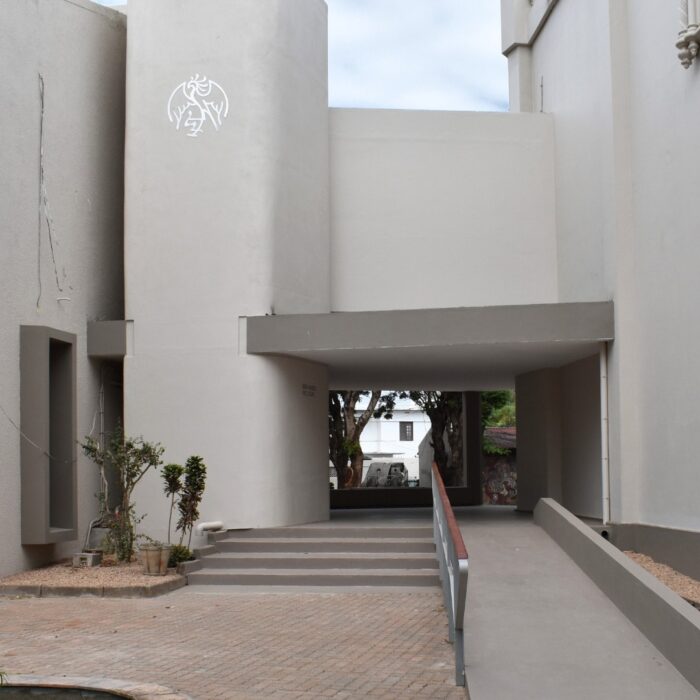
The museum was founded in 1911 and housed in a historic Manueline-style building since 1933. It now boasts a more modern, inclusive feel, and is ready to welcome students, researchers, and tourists.

Closed in October 2023, the museum underwent a comprehensive renovation, encompassing everything from its architectural structure to its museological and museographic aspects. Improvements include the installation of solar panels, air conditioning and lighting systems, indoor restrooms, an elevator, and access ramps for people with disabilities. A room for temporary exhibitions, a bookstore, and a café were also built.

In the exhibition space, all exhibits were restored and given a modern museological approach, showcasing habitats and species in their natural relationships. Rooms dedicated to seagrasses and large marine fauna were introduced, as well as new accessibility features, including information adapted for people with audiovisual impairments.

One of the new features is the creation of an ethnographic room with approximately 500 objects linked to the cultural practices of different Mozambican peoples, including art, sculpture, music, jewelry, ceramics, and basketry, complemented by a historical photographic collection.

The renovation, budgeted at 4.25 million euros, was led by Italian and Mozambican experts affiliated with the Sapienza University of Rome, in partnership with the Anton Dohrn Zoological Station and the NGO WeWorld. Funding came from the Italian Ministry of Foreign Affairs and International Cooperation, through the Italian Agency for Development Cooperation (AICS).

(By MozaVibe)

China as an example of food self-sufficiency

Mozambique needs “a clear strategy for agricultural and industrial development, based on scientific knowledge, local adaptation and sustainability.”

Photo: UEM

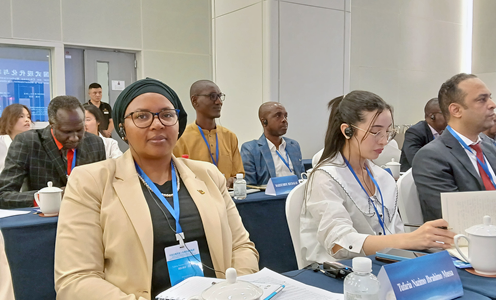
China, one of the world's largest agricultural producers, is a model to be replicated in the quest for food self-sufficiency. This is the view of Tufária Mussá, a professor and researcher at Eduardo Mondlane University (UEM), after participating in the seminar "Chinese-Style Modernization and Development of Africa," held in Shaanxi Province, China.

According to Mussá, Mozambique needs "a clear agricultural and industrial development strategy, based on scientific knowledge, local adaptation, and sustainability."

The professor also highlighted the importance of encouraging production, strengthening value chains, investing in technology, and promoting political and institutional reforms.

The event brought together representatives from 50 African countries and was part of the implementation of the "10 Actions for China-Africa Cooperation 2035," aligned with the Changsha Declaration, which advocates for greater solidarity and cooperation between the continent and the Asian giant.

At the opening ceremony, China's Special Envoy for African Affairs, Xue Bing, reaffirmed the commitment to strengthening the partnership with Africa, recalling the historical support for liberation movements and structural projects, such as the Moatize-Nacala railway.

The program included lectures and visits to strategic infrastructure, such as the Yangling Demonstration Park, an example of agro-industrial modernization.

(By MozaVibe)

Estonian University to train Mozambican teachers

Academic diplomacy at UEM. Photo: UEM

Tallinn University (TLU) will train Mozambican teachers as part of a partnership between the Estonian institution and Eduardo Mondlane University (UEM).

This is the result of a recent international academic diplomacy event in Maputo, when delegations from TLU and the Portuguese Polytechnic Institute of Management and Technology (ISLA) visited UEM.

In addition to training teachers, TLU, a European reference in educational and technological innovation, has come up with bold proposals for academic mobility and even film collaboration through the TLU Film School and the UEM School of Communication and Arts. In fact, the two institutions have had a formal partnership since February 2025.

The meetings will also be held at the Inhambane School of Hospitality and Tourism (ESHTI), with a focus on discussions about UEM's digital transformation, in line with its strategic objectives.

However, with ISLA, the two institutions have focused on entrepreneurial education, support for the UEM Business Incubator, and concrete possibilities for scientific publication for postgraduate students.

In this sense, a memorandum of understanding between the institutions is in the final stages of preparation.

(By MozaVibe)

João Neves: UEM must take a leading role in biotechnology

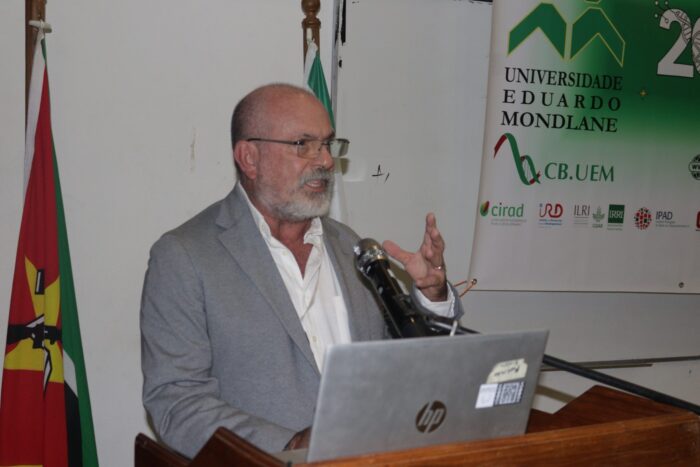
João Neves. Photo: UEM

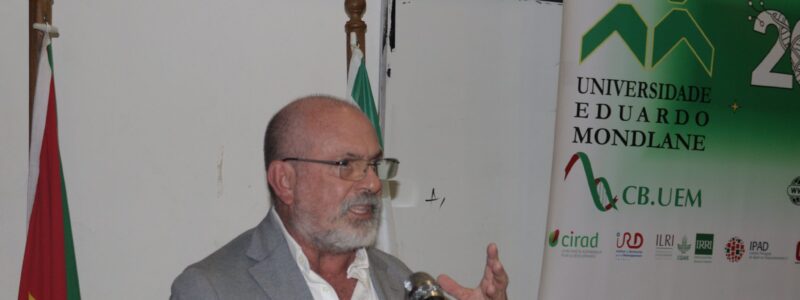
Eduardo Mondlane University (UEM) must assume its leading role in Biotechnology and consolidate the Eduardo Mondlane University Biotechnology Center (CB-UEM) as a national platform for training, research and scientific innovation.

This is the position of professor and researcher João Neves, co-founder of CB-UEM, who spoke recently in Maputo during the celebrations of the 20th anniversary of that center.

According to the researcher, a more robust mobilization of resources is essential and, eventually, the creation of its own infrastructures that support the growth and excellence of CB-UEM, which must be “recognized as a national observatory of genetic resources”.

UEM needs to redouble its efforts to guarantee scholarships at master's and doctoral levels. “We must maintain and enhance our crown jewel: the Master’s in Biotechnology. This requires creativity and commitment to mobilizing resources and creative solutions,” he said.

In turn, the rector of UEM, Manuel Guilherme Júnior, recalled that, since its creation in 2005, the center has contributed decisively to the advancement of science in Mozambique.

“CB-UEM has been a privileged space for training highly qualified professionals, some of whom now hold leadership positions in public and private institutions,” said the Rector, also highlighting projects with a direct impact on the areas of health, agriculture, the environment and the development of partnerships with national and international institutions.

(By MozaVibe)

UEM creates “Room of the Future”

Photo: UEM

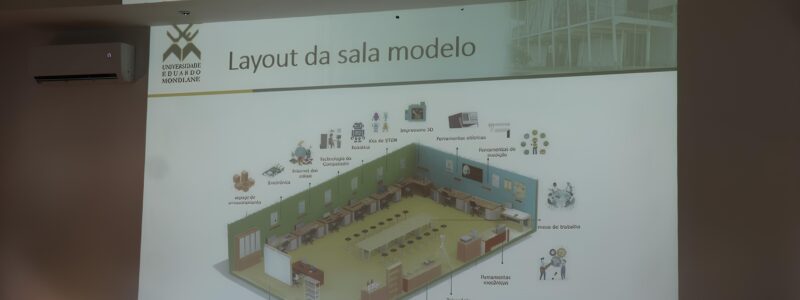
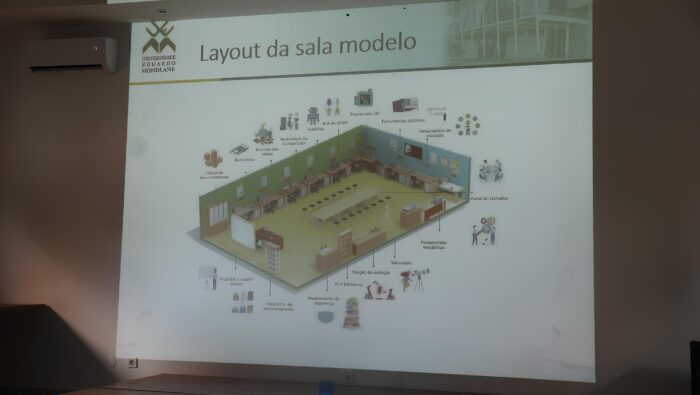
Eduardo Mondlane University (UEM) has begun the creation of its first “Room of the Future”, an innovative and multidisciplinary space designed to transform the teaching of Science, Technology, Engineering and Mathematics (STEM) in Mozambique.

The new teaching environment will be equipped with science kits, robotics and advanced digital technology, providing students and teachers with a modern platform for experimentation, collaborative learning and the development of solutions to real-world challenges.

With a practical and integrated approach, the “Room of the Future” aims to break down traditional barriers to teaching, functioning as an educational workshop where different areas of knowledge are interconnected in dynamic learning experiences.

The initiative is part of the “MozSkills” project, with the aim of training teachers in the provinces of Maputo and Gaza, strengthening the internal knowledge base in STEM areas. It is expected that the qualified training of these professionals will contribute to increasing students’ interest in science and technology, boosting the country’s socio-economic development.

UEM thus reinforces its commitment to innovation and academic excellence, positioning itself at the forefront of educational transformation in Mozambique.

(By MozaVibe)

Xironga will always occupy a special place

The work integrates different linguistic skills. Photo: UEM

A report on the possible extinction of Xironga worried Armando Magaia. The linguist was so concerned that he decided to do something to help this language, which is typical of the southern region of Mozambique.

According to the author, the document stated that Xironga could disappear within the next 50 years. To counter this trend, Armando Magaia had the brilliant idea of ​​creating a grammar.

The project bore fruit and the book, entitled “Gramatka Dza Xizronga”, was recently presented at Eduardo Mondlane University (UEM), in Maputo. The work includes different linguistic skills such as phonetics and phonology, spelling and morphology, compiled from field research conducted by the author in communities that speak this language.

“Despite being an English teacher in UEM language courses, Xironga will always have a special place, as it was my first language. However, producing the grammar is a way of slowing down its extinction”, he stated.

The grammar will contribute to the promotion and valorization of Mozambican languages ​​by giving them a scientific and systematized basis. At least this is the thinking of fellow linguist Julieta Langa, who presented the book.

“The work expresses the importance of research into national languages ​​so that they can be shared between the academic community and society in general, facilitating their use and thus ensuring their existence in future generations”, she maintained.

Armando Magaia holds a PhD in Languages, Linguistics and Literature from the University of South Africa (UNISA) and has been teaching English, Study Skills, Translation and Interpretation at UEM since 2006.

(By MozaVibe)

Dr. Fridtjof Nansen explores mozambican waters

Dr. Fridtjof Nansen. Photo: IMR

The research vessel Dr. Fridtjof Nansen, operated by the Norwegian Institute of Marine Research (IMR), has embarked on a scientific expedition in waters under Mozambican jurisdiction. It aims to deepen knowledge about marine ecology and population dynamics of fisheries resources in the country.

The expedition is investigating spawning grounds, early stages of marine life, adult stock dynamics, genetic diversity and climatic and environmental factors. The information obtained will be essential to ensure food security and sustainably promote Mozambique’s blue economy.

The first phase of the expedition, focused on the larval stages of marine resources in the Sofala Bank, was successfully completed between 9 and 25 February. The Sofala Bank, vital for fisheries and the local economy, was the focus of the research, which provided important data on the abundance, distribution and survival of larvae, fundamental aspects for the sustainable management of fisheries resources.

These data will be integrated with oceanographic information and computer models to predict fish stocks and the impacts of environmental changes, helping to formulate conservation and sustainable use strategies.

The second phase of the expedition, which covers fisheries resources along the Mozambican coast, from Rovuma to Maputo, began on 28 February and will continue until 31 March. The vessel “Dr. Fridtjof Nansen” will continue its journey in other regions of the Indian Ocean.

In addition, the vessel will return to Mozambique in October for the third phase of the expedition, which will focus on mapping the seabed habitats of the Sofala Bank.

The expedition involves a multidisciplinary team of 43 scientists from several Mozambican institutions, including InOM and Eduardo Mondlane University. This collaboration reinforces the commitment of the Government of Mozambique to excellent marine research, both nationally and internationally.

This is an initiative of the Ministry of Agriculture, Environment and Fisheries (MAAP), in partnership with the Oceanographic Institute of Mozambique (InOM), the Food and Agriculture Organization of the United Nations (FAO), the Norwegian Institute of Marine Research (IMR) and Eduardo Mondlane University (UEM).

(By Renaldo Manhice)