
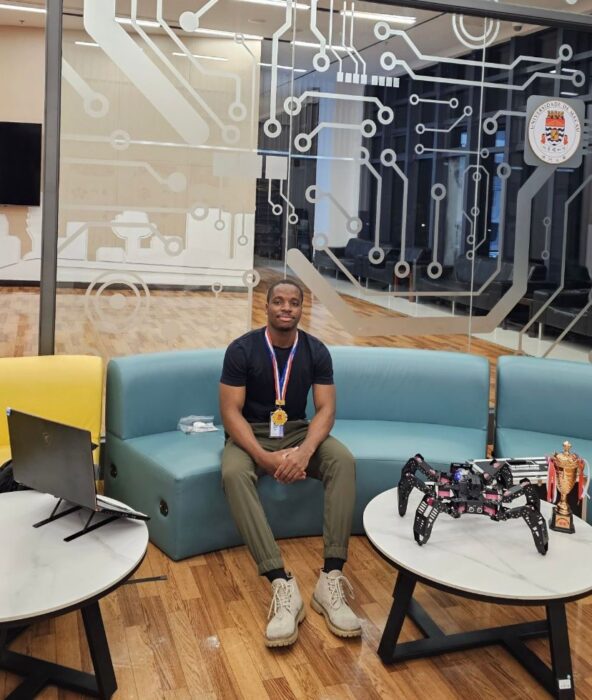
Magne Dina Neves, who is studying Electrical and Computer Engineering at the University of Macau, achieved first place in the robotics category at the IoT Data Hackathon 2026, standing out among participants from various parts of the world.
Technological innovation gained international prominence with the achievement of a Mozambican student in one of the most recent global robotics challenges held in Hong Kong.
Magne Dina Neves, an Electrical and Computer Engineering student at the University of Macau, won first place in the robotics category at the IoT Data Hackathon 2026, standing out among participants from around the world.
The competition was organized in partnership by GS1 Hong Kong, Cyberport, and the Hong Kong Science and Technology Parks Corporation (HKSTP), bringing together academic teams, startups, and technology professionals.
The student's project was developed based on a six-legged robot and combined different areas of engineering and artificial intelligence. The solution allows for autonomous locomotion on varied terrains, real-time detection of potentially hazardous materials, and continuous collection of environmental data, which can be monitored remotely for analysis and safety purposes.
In addition to his performance in the competition, Magne Dina Neves has an academic and professional trajectory marked by numerous distinctions. The young man is an alumnus of the African Leadership Academy (ALA) in South Africa, where he is a member of the Alumni Honor Council. He is currently the president of the International Student Association at the University of Macau and a member of the Robotics Club at the same institution.
In 2024, the student had already been awarded the Best Student Paper prize at the International Integrated Reliability Workshop (IIRW), reinforcing his trajectory in the field of scientific research.
The IoT Data Hackathon 2026 took place at the Hong Kong Convention and Exhibition Centre, as part of the InnoEX 2026 technology fair.
This year's edition featured more than 160 teams from universities, startups, and professionals, distributed across two major thematic areas: technological and business innovation, and social impact and sustainability.
(By Renaldo Manhice)