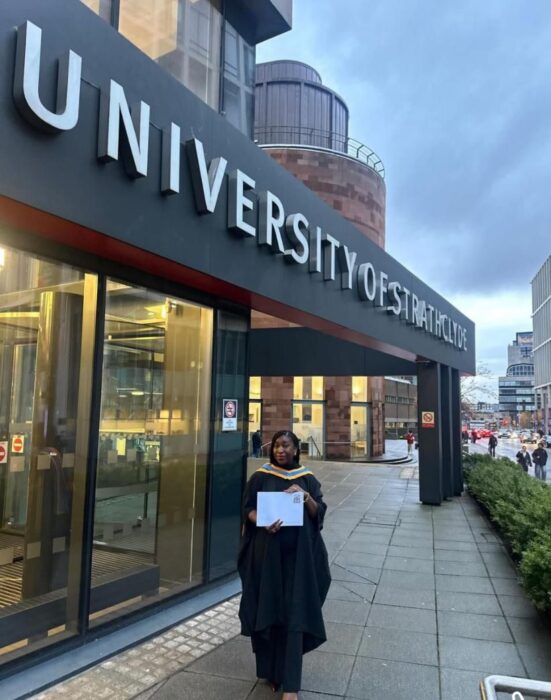


In a country where access to international scholarships is still not widely publicized, the story of Elina Ricotso Chiluvane emerges as an encouragement for young people who believe that studying abroad is a distant dream.
A mother, married, and a professional in the financial sector, she built her career based on persistence and the conviction that success depends more on preparation than on extraordinary talent. This is how she won the prestigious Chevening scholarship, one of the most competitive in the world.
Graduated in Accounting and Finance from Eduardo Mondlane University (UEM) in 2018, she worked for six years in the financial sector. Despite her experience, she felt she needed to go further.
“There was a gap in the area of financial planning and reporting. I wanted to broaden my knowledge and have a wider horizon,” she explains. This desire for professional growth became the starting point for her application.
The opportunity arose through her husband, who told her about Chevening. From that moment on, she began an intense research phase. She sought information from former scholarship recipients, family, and acquaintances, and immersed herself in the internet to understand the eligibility criteria.
She discovered that it was necessary to have a bachelor's degree, fluency in English, and meet the academic requirements of the universities, in addition to submitting a solid application. The fact that the scholarship was fully funded reinforced her confidence.
The application process proved demanding. Candidates must write four fundamental essays. The first addresses leadership, requiring real-world examples of impact and transformation. The second deals with networking, showing how the candidate mobilized people and partnerships to achieve objectives. The third explores the reason for choosing the country, the scholarship, and the universities. The fourth requires defining a career plan with short- and long-term goals.
In addition to applying for the scholarship, it is necessary to apply separately to three universities. Elina chose the Master's program in Investment and Finance at the Strathclyde Business School, University of Strathclyde, in Glasgow, Scotland, attracted by the institution's academic reputation.
To increase her chances of success, she connected with candidates and fellows from various countries, participated in international groups, sought mentorship, watched videos, and simulated interviews. “The research and preparation made all the difference,” she says.
Even with funding, the initial phase involved personal costs. Among them were the academic English exam, the tuberculosis test, and communication and internet expenses. In total, she estimates having spent around 50,000 meticais.
One of the most difficult moments was when the tuberculosis test was inconclusive due to the flu, delaying the process and almost jeopardizing the opportunity. Determined, she managed to postpone the scholarship until the following year, something uncommon. “It was a lesson in persistence. We can't give up,” she recalls.
BEST AFRICAN STUDENT
Her academic journey was not easy. As a non-native English speaker returning to academia after six years, she faced linguistic and methodological challenges. Even so, she managed to overcome them and transform difficulties into achievements. She graduated with Distinction, obtained a High Performance Certificate, and received the Bashourun Abiola Award in Accounting and Finance, given to the African student with the best academic performance in the department.
After returning to Mozambique, she found employment in financial planning and analysis, achieving the goal that had motivated her from the beginning. Today, she shares her experience with other young people and insists that the main secret is having clear objectives and believing in one's own potential.
“You don't need to be a genius to get a scholarship. You need focus, preparation, and hard work,” she emphasizes.
For Elina, it is crucial that scholarship opportunities are more widely publicized in the country, allowing more young people to access international training. Her trajectory leaves a clear message: dreams become possible when there is information, persistence, and courage to face challenges.
(By Renaldo Manhice)